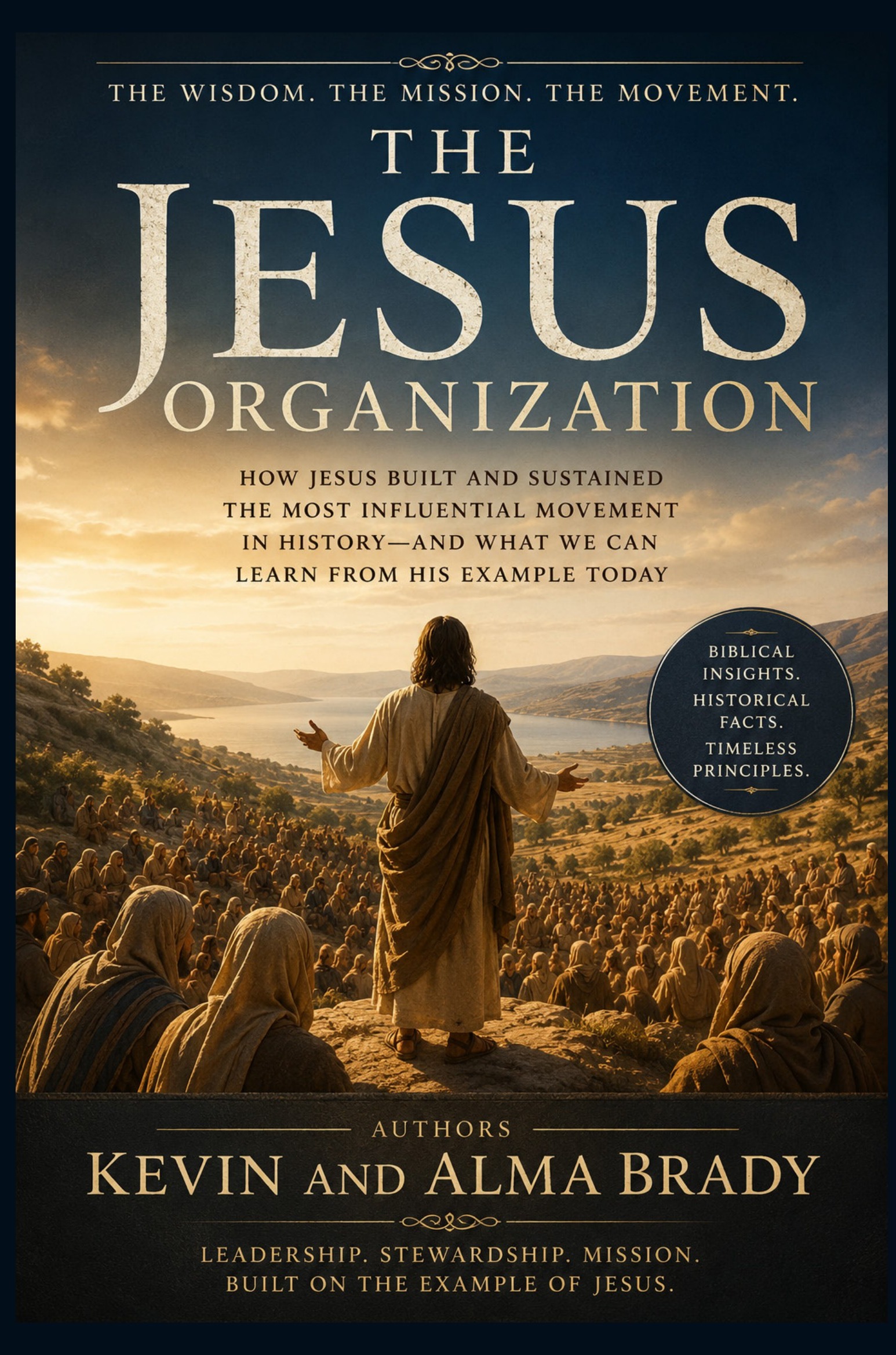
The Jesus Organization
How Jesus built and sustained the most influential movement in history — and what we can learn from His example today.
Not just a teacher. A master organizer.
In just three years, Jesus of Nazareth launched the most influential movement in human history. He traveled thousands of miles, taught multitudes, trained leaders, provided for thousands, and built a mission that outlived His death and continues today — all without wealth, buildings, or political power.
How did He do it? The Gospels reveal more than we often realize about the organization, relationships, and strategies behind His extraordinary ministry.
The Jesus Organization uncovers the biblical and historical foundation of how Jesus built and sustained a movement that changed the world — and what we can learn from it today.
Biblical insights. Historical facts. Timeless principles. Practical applications.
Inside you'll discover
- ◆How Jesus built a leadership team and developed future leaders.
- ◆Who supported His ministry — and how it was funded.
- ◆How travel, lodging, and logistics were arranged.
- ◆How He organized and cared for large crowds.
- ◆Who managed finances and resources.
- ◆How information spread so quickly without modern technology.
- ◆Why His mission model continues to work in every generation.
Now Jesus went about all the cities and villages, teaching in their synagogues, proclaiming the good news of the kingdom and healing every disease and every infirmity. The Twelve were with him, and also some women… These women were helping to support them out of their own means.
The authors

Kevin Brady is an entrepreneur, author, and technology innovator who has spent decades building organizations, developing technology solutions, and studying the principles that enable missions to succeed.
Alma Brady is a devoted wife, mother, and follower of Christ whose passion for faith, service, and discipleship helped inspire this work.
Together, they have devoted themselves to raising their family with a foundation of faith, freedom, responsibility, and service, and have helped launch Amane House, a Christian mission serving the local community and fostering spiritual growth among families and youth.
From the book to your organization
The Jesus Organization Index turns the book's principles into a measurable instrument. Assess your leadership across nine categories, then work the chapters as facilitator-led workshop sessions.
Free chapter guide (PDF)
A 14-page companion with the big idea, discussion questions and a weekly application step for all twenty chapters — ready to print for your team.
The twenty chapters
Every chapter maps to the JOI categories it strengthens, and each has a ready-to-run workshop session.
Everything Jesus did flowed from a single, clearly understood mission.
Jesus never improvised His purpose. Every decision, invitation and refusal traced back to one clearly held mission.
Roads, Pax Romana, language and religious institutions shaped the ministry context.
Roads, a common language and a stable empire were the conditions Jesus worked within. Context is not an excuse; it is raw material.
Movements travel through people, ideas, convictions and relationships — institutions do not.
Jesus built a movement, not an institution. Movements travel through people; institutions travel through buildings, budgets and permission.
Selecting and forming a core leadership team around the mission.
Jesus prayed all night, then chose twelve ordinary people and spent most of His time on them rather than the crowd.
Concentric levels of trust and access within a leadership structure.
Peter, James and John saw things the other nine did not. Concentric circles of access are not favoritism; they are capacity.
Sending workers ahead in pairs to extend reach beyond the founder.
Jesus sent seventy-two ahead of Him, in pairs, to towns He intended to visit. Scale came from sending, not from doing more Himself.
The support network that sustained the ministry's daily operations.
The women of the ministry funded, hosted and sustained the daily work. The infrastructure that carries a mission is rarely the part that gets named.
How a traveling ministry was resourced, and who stewarded the money.
A traveling ministry was funded by supporters and stewarded by a treasurer. Money followed the mission; it did not set it.
Homes, hosts and relational networks as operational infrastructure.
Homes were the operating system of the movement. Hospitality was not a nicety; it was logistics, funding and relationship at once.
Routes, distances and the discipline of moving a team on foot.
Moving a team on foot across a region takes planning, pace and margin. Logistics is a spiritual discipline when people are involved.
How word spread rapidly through oral networks, messengers and repetition.
Without printing or broadcast, the message spread through repetition, memorable form and trusted messengers.
Managing scale without losing access to individuals.
Jesus drew crowds but never let scale remove access to the individual. Growth without access becomes performance.
Delegation, grouping, distribution and accountability under pressure.
Five thousand fed: inventory taken, crowd grouped, work delegated, distribution supervised, leftovers collected. Compassion executed as operations.
Withdrawal, prayer and rhythm as the engine of sustained output.
Jesus withdrew before major decisions and after major success. Solitude was the engine, not the reward.
Formation through proximity: watch, participate, attempt, be corrected.
Formation happened by proximity: they watched, participated, attempted, were corrected, then were sent.
Granting real authority and debriefing what was learned.
Delegation without authority is errand-running. Jesus gave real authority, accepted real risk and debriefed the results.
Building leaders who could carry the mission after the founder departed.
Jesus spent His final season preparing people to continue without Him. Succession was the plan, not the emergency.
Multiplication once the mission outgrew a single location.
At Pentecost the mission outgrew one location in a single day. Multiplication requires structures prepared before the growth arrives.
Structure, dispute resolution and stewardship in the first congregations.
The early church created structure in response to real problems — complaints, distribution, disputes — without losing the mission.
Why the design has endured for two thousand years.
The design has lasted two thousand years because it was built on mission, people and multiplication rather than buildings and control.